
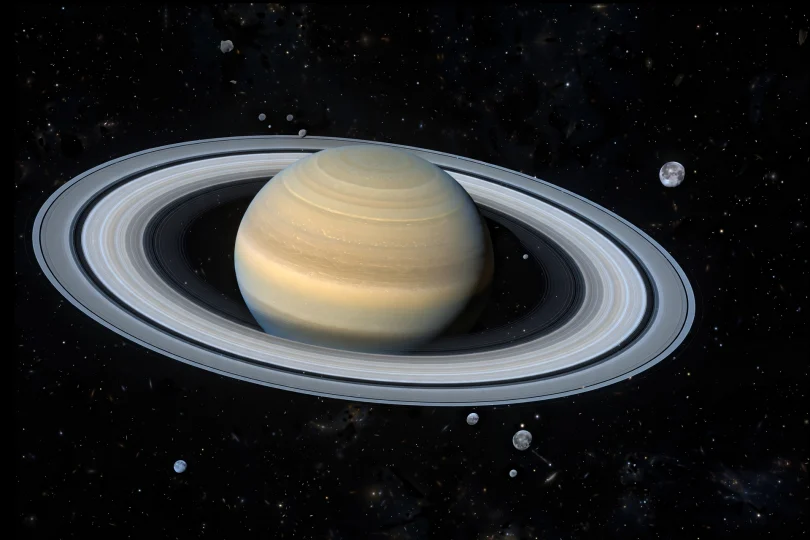

The most interesting technology story in astronomy this year may not involve a new telescope at all. It involves a smarter way of squeezing information out of images: by shifting and stacking years of deep exposures, astronomers have confirmed 128 previously unrecognised moons of Saturn, raising the planet’s official total to 274 — more than every other planet combined.
Tech readers will appreciate the shape of the achievement. The moons did not appear because someone built a bigger mirror. They appeared because a survey team collected data patiently, aligned it cleverly, and let computation do what a single photograph cannot: pull a whisper of light out of overwhelming darkness. The previous confirmed total stood at 146, so the technique has effectively rewritten the record books in one release.
The instrument: a workhorse on a Hawaiian volcano
Observations came from the Canada-France-Hawaii Telescope on Mauna Kea, a 3.6-metre telescope that has been in service for decades. Longevity is part of the story. Modern survey science often depends less on novelty than on sustained observing time, stable instruments and archives that can be revisited as methods improve. More detail about the facility and its instruments is published by the Canada-France-Hawaii Telescope itself.
The team, which included Dr Edward Ashton and colleagues associated with the University of British Columbia, spent several years building the dataset. Each observing run added faint frames. Individually, most of the new moons are far too dim to register convincingly. Collectively, processed the right way, they become undeniable.
Shift and stack, explained
Imagine photographing a dark road at night while moving. Distant streetlights smear one way; an object travelling with you stays sharp. Shift and stack applies a version of that logic to the sky. Software shifts each exposure by the amount Saturn and its retinue are expected to have moved, then stacks the aligned frames. Light from a genuine moon lands on the same pixels again and again and builds into a clear detection. Random noise does not cooperate, and background stars trail differently, so both are suppressed.
The method demands accurate motion predictions and a lot of computing discipline. It also demands follow-up: a smudge in stacked data is only a candidate until repeat observations pin down an orbit well enough for the International Astronomical Union to recognise the object as a moon. That recognition has now been granted to all 128.
It is a fitting companion to the data-heavy stories Techyam covers daily, from warnings about AI reshaping the web to the computing build-out behind them: in field after field, the breakthrough is increasingly in the processing, not just the sensor.
Meet the irregulars
The new arrivals are irregular moons, and the name fits. They are typically just a few kilometres across. Their orbits are distant from Saturn, tilted at awkward angles, and in many cases retrograde — looping around the planet against the direction of its spin and against the flow of its big, well-behaved moons.
Planetary scientists read those orbits like a fingerprint. Moons born with Saturn, from the disc of material that surrounded the young planet, should orbit in that disc’s plane. Irregulars almost certainly did not. They are best explained as passing bodies — fragments of asteroids or comets — captured by Saturn’s gravity and kept ever since.
Collision debris, preserved in orbit
Capture is only the first chapter. Many of the new moons appear to belong to families: groups sharing similar orbital characteristics, as if they were once a single larger object. The natural inference is a collision. A captured moon, struck by something else in the crowded outer system, broke apart, and its fragments drifted on together.
That makes the catalogue a forensic record. By counting fragments and reconstructing their orbits, researchers can estimate when break-ups happened and how violent the Saturn system has been. It is slow-motion archaeology conducted with telescopes and orbital mechanics instead of trowels.
What better processing finds next
There is no reason to think 274 is the final number. Deeper stacks, longer baselines and improved algorithms may push the detection limit to still smaller fragments, at Saturn and around the other giant planets. Each improvement in software effectively upgrades every archive ever collected — a very technology-industry outcome, in which old data appreciates rather than depreciates.
For now, Saturn’s lead is commanding, and the method behind it is the real headline. A mature telescope, years of disciplined data collection and an elegant computational trick have revealed a swarm of worlds that was always there, waiting for the processing to catch up.