
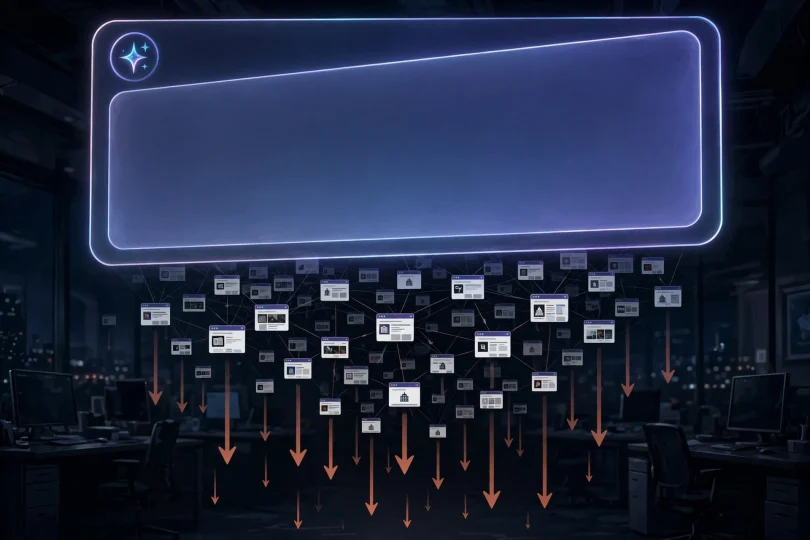

Internal Microsoft documents that have surfaced in court proceedings reportedly warned, in blunt language, that the company’s artificial intelligence strategy risked setting off a self-reinforcing decline for the open web. According to reporting on the unsealed filings, one internal assessment described the company’s AI content strategy as having started a “doom loop” — a cycle in which AI-generated answers satisfy readers directly, fewer readers click through to the websites that originally produced the reporting, research and creative work, and those websites then earn less money and can afford to produce less of the very material AI systems depend on.
The warning matters far beyond one company or one lawsuit. It describes, in a technology company’s own internal terms, the central economic tension of the AI era: answer engines need a healthy web to learn from and to cite, yet the more complete their answers become, the less reason a reader may have to visit the source at all.
What the Reported Warning Actually Says
Coverage of the filings by TechCrunch and other outlets says the documents came to light in The New York Times’ copyright case against Microsoft and OpenAI in the United States. The plaintiffs argue that news content was copied at scale to train and operate commercial AI systems. The defendants have defended their practices, and the claims have not been finally decided by the court.
Within that dispute, the reported internal language is notable for two reasons. First, it connects AI answers directly to traffic losses for publishers, rather than treating referral traffic as a side issue. Second, it frames the harm as a risk to the AI products themselves, not only to publishers. If fewer original sites can sustain reporting, photography, data collection and specialist writing, then future training and grounding material becomes thinner, older and less reliable.
Readers should treat individual internal remarks carefully. A comment by one executive in a memo or presentation is not automatically a company’s official position, and companies in litigation routinely argue that selected excerpts lack context. Even with that caution, the fact that such a warning was reportedly written inside the company gives it weight in the public debate.
How a Doom Loop Would Work
The mechanism is simple to follow. Traditional search sent readers onward. A results page offered links, and publishers converted those visits into advertising, subscriptions, affiliate revenue and direct sales. AI answer features change that flow. When a summary at the top of the page answers the question fully, the click becomes optional.
For large national publishers, a fall in search referrals is painful. For smaller specialist sites — a local newsroom, a niche science blog, a product-testing site or an independent magazine — it can be existential. Those sites often rely on a small number of high-intent searches. Lose enough of those visits and the economics of commissioning original work quickly break down.
That is why habits that once seemed purely administrative now matter more to publishers, from audience analytics to keeping transaction records that show exactly which revenue lines depend on search traffic. Without clear records, a publisher cannot tell whether a traffic dip is seasonal, technical or structural.
Why Publishers Are Especially Exposed
Publishing has high fixed costs and fragile margins. Reporting requires people, time, travel, legal review and technology. An AI answer, by contrast, can summarise published work in seconds. If the summary replaces the visit, the publisher bears the cost of production while the platform captures the reader’s attention and, often, the advertising value around it.
The reported filings also highlight a second concern: substitution. If executives internally described AI products as largely substitutive for source sites, that language will interest lawyers testing fair-use arguments, which in the United States consider, among other factors, the effect of a use on the market for the original work. Again, internal phrasing does not decide a case, but it can shape how judges and the public understand intent and impact.
What Could Break the Cycle
Several responses are already being debated. Licensing deals pay some publishers for content, though critics ask whether smaller outlets will be included and whether payments match lost traffic. Clearer citation and more prominent links could restore some click-through, especially when answers draw heavily on a single source. Technical standards that let sites control how their content is used for training, while still allowing ordinary search indexing, are another part of the discussion.
Publishers, for their part, are diversifying. Newsletters, podcasts, events, memberships and direct apps reduce dependence on any single referral source. Original data, first-hand reporting and community trust are harder for a summary to replace than commodity explainers rewritten from other sites.
The Bigger Question for the Web
The open web grew because creating a site was cheap and being found was possible. Search rewarded useful pages with readers, and readers funded more useful pages. The reported doom-loop warning suggests that insiders saw a risk that AI could interrupt that bargain.
Whether the courts ultimately accept the publishers’ claims, and whether Microsoft or OpenAI change product design in response, the underlying question will remain. An AI ecosystem that weakens its own sources will eventually weaken itself. Protecting a route from answer to source — through links, licensing and sustainable economics — is therefore not charity toward publishers. On the logic of the reported warning itself, it is maintenance for the web that AI needs to survive.