
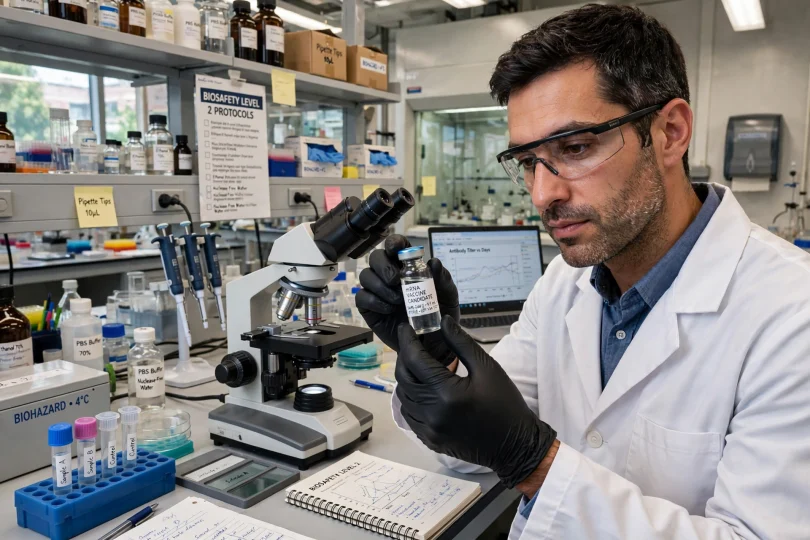

Personalised medicine usually describes a drug chosen for a patient. NeoVax goes further: it is a vaccine manufactured for one patient at a time, designed from the mutations in that person’s own tumour. In a phase 1 trial published in Nature Medicine, researchers combined NeoVax with the immunotherapy drug nivolumab in platinum-sensitive recurrent ovarian cancer — and showed the approach is feasible to make, acceptable on safety, and capable of provoking measurable T-cell responses.
Those three findings are the story. They are also the limit of the story. This was a small, early study designed to answer whether a complex idea can be executed in practice, not whether it cures cancer or extends survival. Keeping that distinction clear is what separates health reporting from hype.
Built from a tumour’s mutation list
The science starts with neoantigens. As a tumour grows, it accumulates genetic errors. Some errors change the proteins its cells display, creating fragments that look foreign to the immune system. NeoVax is built by analysing a patient’s tumour, predicting which of those fragments are most likely to be recognised, and synthesising a vaccine around them.
Every step is a technology pipeline as much as a medical one: biopsy, sequencing, algorithmic prediction, bespoke manufacturing and quality control, all while the patient’s disease is being managed. Readers who follow the intersection of computing and medicine — a theme running through our coverage of how AI is changing the web’s economics and the infrastructure behind it — will recognise the pattern. Prediction quality determines product quality.
The partner drug: releasing the brakes
Nivolumab, the second half of the combination, is a PD-1 immune checkpoint inhibitor. Healthy immune regulation uses checkpoints like PD-1 to prevent T cells from running out of control; cancers exploit those same switches to hide. Blocking PD-1 removes one layer of that protection, allowing T cells to stay active for longer.
Pairing the two has a clear rationale. A vaccine can point T cells at tumour-specific targets, but those cells may still be shut down when they arrive. A checkpoint inhibitor can keep them switched on, but works best when there is a target worth attacking. Whether that logic produces clinical benefit is exactly what later, larger trials must determine.
Reading the results without inflating them
The published findings support three careful statements. The vaccines could be manufactured and administered to trial participants. The safety profile was acceptable for an early-phase combination. And immune monitoring detected T-cell responses, indicating the vaccines engaged the immune system as designed. The trial’s details are set out in Nature Medicine.
What the study does not show is equally important. It does not demonstrate that tumours shrink because of the vaccine, that patients live longer, or that the combination outperforms existing options. Phase 1 studies are not sized or structured to answer those questions, and recurrent ovarian cancer is a setting where early promise has often failed to survive larger testing. Scepticism here is not pessimism; it is method.
General information about ovarian cancer, its recurrence and current treatment approaches is maintained by the National Institutes of Health and its cancer institute, and is a useful counterweight to any single study’s headlines.
The manufacturing question
Beyond biology, the trial highlights a scaling problem familiar to any technology audience. A treatment that must be designed and built individually cannot be stockpiled. Turnaround time, cost and quality assurance all become part of the therapy itself. Feasibility in a controlled trial is the first proof that the pipeline holds together; making it routine, fast and affordable is a separate engineering challenge that will decide how far the approach can travel.
That is also why feasibility results deserve coverage in their own right. Many elegant therapies die in logistics long before biology gets a fair test. A study showing the full chain — tumour in, vaccine out, patient treated, immune response measured — removes one layer of doubt and lets the field argue about the next one: efficacy.
Where the research goes from here
The path forward is conventional and demanding: larger trials, comparison groups, prespecified measures of clinical benefit, and longer follow-up. Researchers will also want to learn which patients generate the strongest immune responses and whether those responses correlate with better outcomes — the bridge between an interesting immunology result and a useful medicine.
For now, NeoVax with nivolumab stands as a well-executed early experiment: manufacturable, tolerable and immunologically active in a hard-to-treat cancer. That is a genuine advance in method. Whether it becomes an advance in outcomes is a question only bigger trials can answer.